

Plateaus: The Shape of Learning & Improving
I heard about this in a drawing class when I was just starting out, but at the time, I hadn’t experienced it yet. This is the concept of plateaus:

When you are trying to learn how to do something, or improve at a skill, it will never be linear. What happens very early on the path of learning something is that if you’re starting from zero, everything bit of information you take on is new. It’s a flood of ideas and concepts, and usually, if you’re being taught in the right order, you will be taking on fundamentals that will become the foundation of that skill.
Usually, when someone takes a beginner drawing class, they start with simply making marks on a page. Lines, squiggles, scratches – all to learn what the tools can do. Then you draw circles, and then move on to geometric volumes – cubes, boxes, cylinders, cones. That’s a lot for your brain and coordination to take on. So you practice that for a while.
Then you learn to put those things together to create the foundations of drawings. You can make a whole person out of boxes in the right size and order (or spheres, or cylinders).
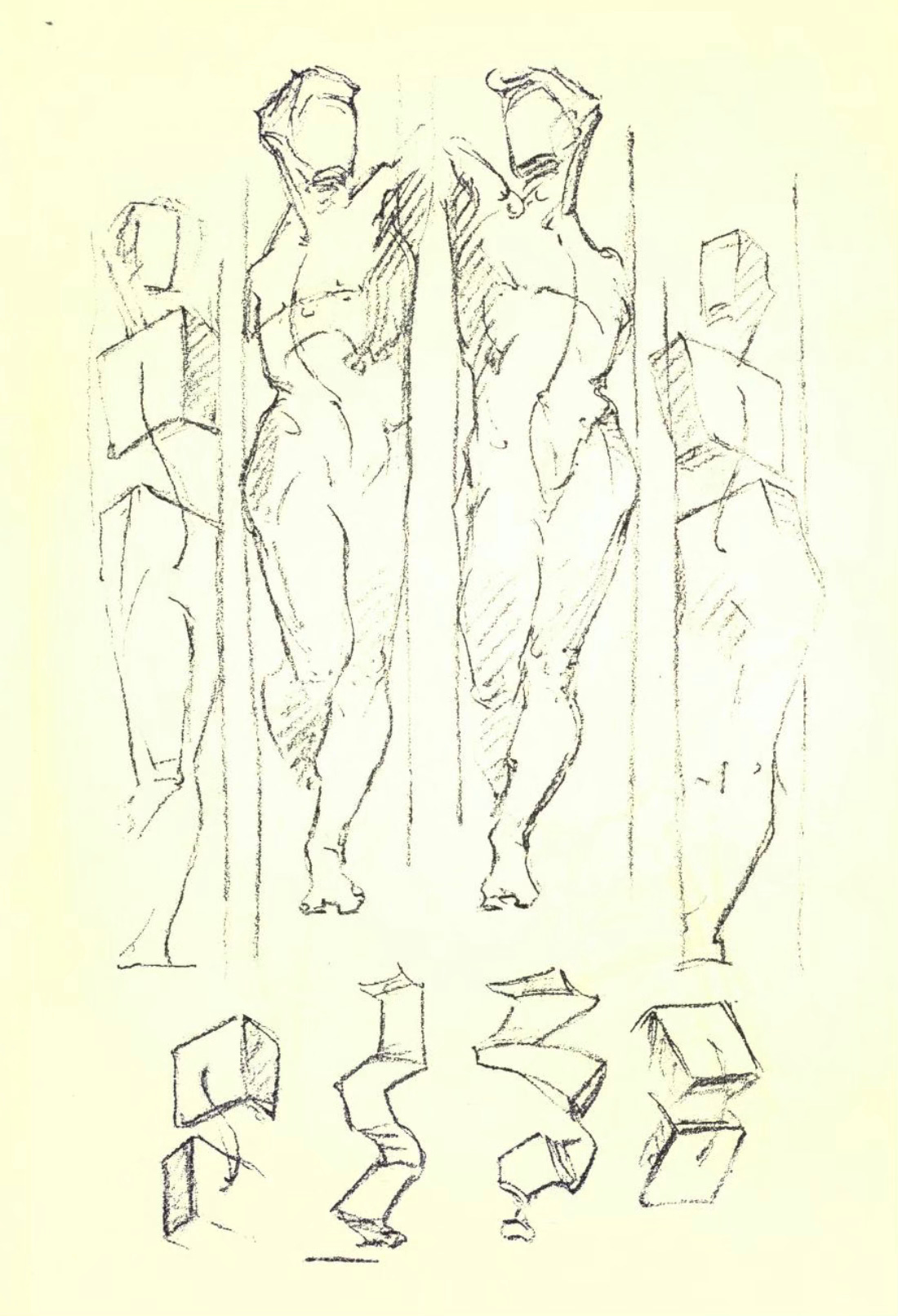
It’s at this point you start focusing on creating representations of ideas. Sometimes the goal is to create something beautiful. Or realistic. Or abstract. Or aggressive. Whatever your goal is, if you don’t have the skill to convey what you’re attempting, it can be very frustrating.
These are the times in your creative journey when you will feel like you’re hitting a wall, and even though you keep working at it, you just can’t seem to improve. This place is a plateau. You’ve stopped improving, no matter how hard you try.
I experienced this when I was trying to build my first drawing portfolio so I could get a job as an animator. There would be weeks or even months when my drawing would not improve, no matter how hard I tried. I would finish a drawing class and throw everything in the trash because none of it was better than what I already had drawn. It was infuriating, honestly, and if I didn’t have that goal of getting a job or other friends who were trying to do the same thing, I probably would have given up.
But I didn’t give up, and this is what I realized, which also happens to be the most important message of this article: If you keep working at whatever you’re learning, those plateaus are actually when you should be getting excited. Why would stagnation and frustration be a cause for excitement? Because one day you will sit down to draw, and everything will miraculously jump to a new level. Things you couldn’t do before will just happen. Mistakes you’ve made a hundred times will be corrected. A new technique will replace something you’ve hated in your work up until now. You will have broken out of the plateau, and now you’re growing again.
And there’s no way of predicting how long this growth spurt will last or how steep it will be, so you have to dig in and ride the wave. Take advantage of this mystery that is happening and crank as hard as you can. Don’t question it, just keep working. Your skills will improve and as they do, you should focus on the next mountain you want to conquer. Is it expression, storytelling, hands, shading, flow? Whatever it is, consciously put it in your mind to work on that alongside this new growth you’re experiencing.
Hopefully, if you’re smart and paying attention, these new skills that have appeared won’t go away because you are recognizing them and strengthening them with more use. You have to be aware of what’s happening on some level, or these improvements really can become a coincidence that disappears. This is why you have to keep working and don’t slow down.
The best part about this is that you probably won’t slip back to previous levels if you keep working, or basically practicing whatever it is you’re doing. Sometimes when you are trying something new or someone teaches you a different technique, it will feel like you’re slipping below where you were – and that can be scary. Scary enough that some people find a comfort zone and stay there because they don’t want to change what’s working for them. They don’t want the discomfort of not knowing how to do something new, so they maintain by practicing the same things they’ve always done and simply exist on a constant plateau. Everyone makes their choice on this, but I think it’s better to be uncomfortable and possibly learn how to do something new.
There’s something in this I want to focus on – if you keep practicing the same thing, you will get good at that thing, but not more. So you have to be aware of what your weaknesses are, or a nicer way to put that is, what you’d like to be better at. Is it drawing faces, or horses, or cars, or environments? Whatever it is, you have to add that to your mix, or you’ll never get better at it. My first drawing portfolio I put together didn’t have one face. Everyone was turned away. I see this sometimes where drawings have no hands or feet - because that shit is hard to draw. You have to be willing to make terrible drawings of faces and hands if you want to get to the point of drawing okay faces and hands, which will one day lead to good faces and hands. But if you’re unwilling to try, you’ll never improve.
This is where the creative struggle really exists. Believe me, I’ve been at the bottom of this hole. You hate the way you draw. You can’t make the images you imagine. And it would be so easy to give up and focus on things you’re already good at. But, if you’ve ever worked hard enough to experience what it’s like to break out of a plateau, you’ll know it’s one of the most thrilling feelings in the world. It actually becomes addictive, and that’s why I think some people become great, because that thrill of improving outweighs the pain of the struggle and that’s what drives them onward. Then, after a while, those growing pains are a thing of the past.
I don’t pretend to be in that class of greatness, because I don’t feel like I’ve ever reached that level of excellence in anything. But that’s me, and I know I’m weird that way. Every creative thing I’ve ever tried to do has been painfully difficult, but I DO LOVE it when it’s over, and I have something to show for it. I can say, though, that the more things I do, the easier it all gets and the balance of torture to fun is just starting to even out after 30 years. Your mileage may vary.
For me, drawing, like playing the piano, requires constant practice. If I stop practicing, it’s embarrassing how quickly I forget how to do it. But the good news is, it comes back with a little tune-up and practice, so you never really lose what you’ve worked to gain.
The next time you’re frustrated and stuck on a plateau, focus on what you’re trying to improve and keep going. It may not feel like it, but you’re getting stronger, learning more, banking experience, and it will suddenly all come together – usually when you least expect it – and you’ll see real results as long as you don’t give up. So don’t give up. Keep grinding at whatever you’re trying to get better at, and turn that frustration into excitement because the next level is waiting for you.
Heey! It's so good to see you still sharing inspiration :) Just a quick note that I sent an email to the only email I had for you to invite you as a guest on Toon Talks Podcast - in case you don't get it and are interested I'd love to have you on the cast! It would be great to catch up too!! I hope you're well.